

Inside one of the breakout sessions from the Supply Chain Innovation Forum
On September 9, 2026, Quyntess and PipeChain Group co-hosted the Supply Chain Innovation Forum in Rotterdam, an invitation-only gathering of supply chain and IT leaders. The day ran as a series of breakout conversations; this post recaps one of them, led by Hans Berggren, CEO of PipeChain Group, which took on a question that touches nearly every industry right now: how do you keep a supply chain running when everything around it, costs, demand, geopolitics, weather, keeps shifting?
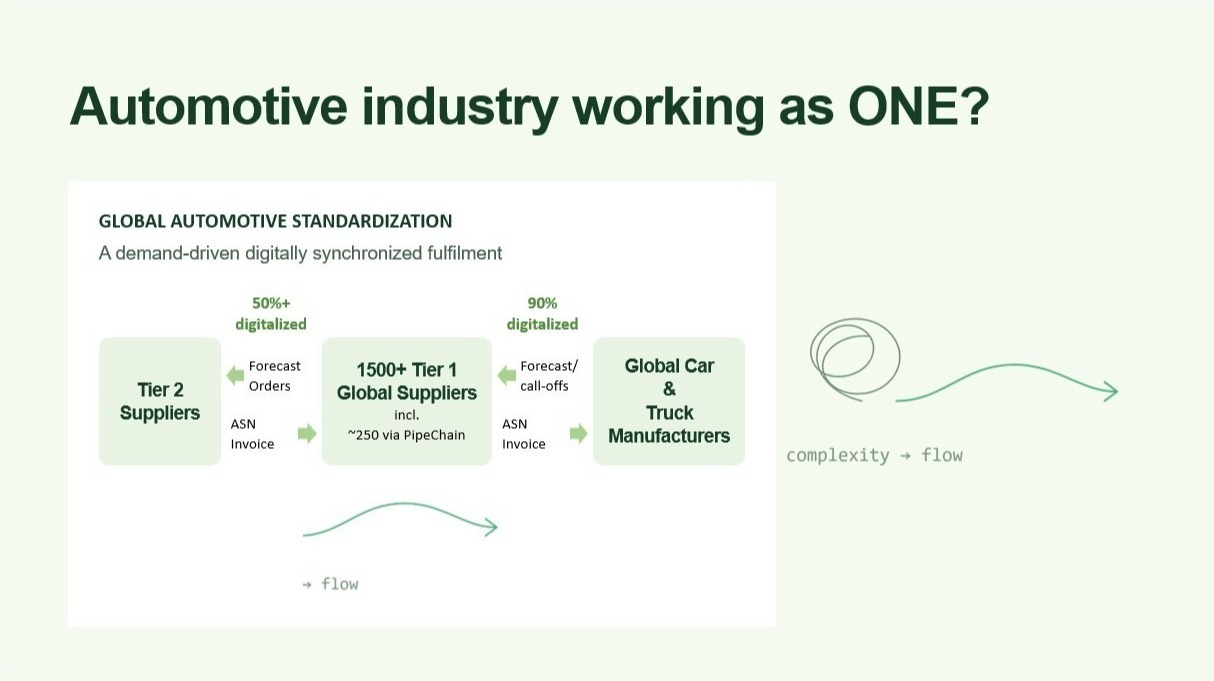
The group drew heavily on the automotive industry, which has spent decades building standardized digital connections between manufacturers and suppliers, and asked what it would take for other sectors to get there too.
The core problem: instability everywhere
The group didn't sugarcoat the challenge. Component shortages, transport disruptions, geopolitical flare-ups, and climate events are hitting supply chains from every direction, while demand itself keeps swinging unpredictably. On top of that, forecasts are often inaccurate and arrive too late to act on. Add in trust issues between trading partners, IT and data strategies that don't line up with what the business actually needs, and constant pressure to cut costs by switching suppliers, and you get a system that's fragile in ways no single tool or policy can fix.
Why this is happening
A few forces are driving the instability. Economically, companies are chasing lower costs through supplier switching and global sourcing, which ironically adds volatility. Demand is also swinging harder year over year; the electronics component shortage came up repeatedly as the example everyone recognized. Culturally and organizationally, the group pointed to a deeper issue: business operations and IT decision-making often live in separate worlds, cross-functional benefits rarely get measured after a new system goes live, and trust gaps between supply chain tiers discourage the kind of deep data sharing that would actually help. Multi-party contracts spanning tier 2 and tier 3 suppliers add their own layer of compliance and visibility complexity, though the group didn't dwell on this.
Many organizations are still running on the assumption that processes are linear and stable, an assumption that no longer holds.
Who controls the data, and why that's the real barrier
One observation cut through the rest: visibility isn't just a technology problem, it's a power problem. Whoever holds the “power node” in a given chain, often the OEM, sometimes a scarce-component supplier, effectively decides who gets to see what. Chip makers were raised specifically as a case where downstream partners have almost no visibility upstream, no matter how sophisticated their own systems are.
That reframes the trust gap mentioned above: it isn't simply that partners are reluctant to share data in the abstract. Data sharing tends to flow one way, toward whoever already has leverage, which gives less powerful tiers little incentive to open up further. Any push for deeper multi-tier visibility has to reckon with that asymmetry, not just the technical mechanics of connecting systems.
What the group agreed should happen
Despite the scale of the problem, there was strong consensus around several concrete moves, though the group was candid that none of these are simple to execute.
Where people disagreed
Not everything was consensus. Three tensions stood out:
-
- How much can AI really anticipate? Someone raised the example of a power plant forced to reduce output because of low water levels affecting cooling, the kind of scenario that's hard to see coming no matter how good the model is. Opinions were split on how far AI-driven forecasting can realistically reach into “unknown unknowns,” which is exactly why AI forecasting was the one recommendation without full consensus.
- How often should partners share live updates? There's a real trade off between responsiveness (sharing changes as they happen) and supply stability (too much noise can cause overreaction up and down the chain).
- Are companies actually measuring the payoff? Several participants noted that strong business cases get built before a rollout, but almost nobody goes back afterward to check whether the promised cross functional value actually showed up.
The conversation is just getting started
The session ended with plenty of energy still in the room. Rather than wrapping up with formal action items, participants were eager to keep exploring, and several said they'd happily have kept going.
The throughline of the discussion was clear: better technology alone won't build a resilient supply chain. Resilience comes from trust between partners, an honest look at who really controls the data, disciplined governance, and organizations that align IT with what the business truly needs. AI plays a powerful role as an accelerant for good judgment, not a replacement for it.
Has your organization tackled multi-tier visibility, or navigated the power-node challenge in your own network? We'd love to pick up where Hans's session left off. Reach out to us or to Hans directly, or tell us what you'd like to see covered at the next forum.
Share this
.png)
The Trump Tariff Effect on Your Supply Chain - Part 1
Patching your Supplier Portal? Time to Upgrade!
-1.webp)