

Some time ago I posted about improving collaborative Master Data Management with suppliers and internal stakeholders, and invited a group of like-minded professionals to join a workshop.
We’ve now run that workshop.
And yes — we gave participants a copy of the game Junk Art in the goodie bag. Not as a gimmick. As a metaphor. Because if you’ve ever played it, you’ll recognize the challenge immediately:
Build something meaningful from pieces of different shapes and sizes, coming from different sources — while multiple people are involved in the process.
Sound familiar?
The reality: Master Data is a multi-player game
In industrial environments, we’re dealing with hundreds to thousands of parts in a single product.
Sourced from dozens to hundreds of suppliers.
But this is not just a procurement problem.
Each part is “touched” by multiple stakeholders, each with their own perspective — or colour, if you like:
- Procurement
- Logistics & Freight
- Quality
- Finance
- Engineering
During the workshop, one customer mentioned up to 1,700 data elements for a single part.
Let that sink in for a moment.
Of course, not every part is that complex.
But the direction is clear: Master Data is no longer simple, static, or owned by one function.
Where it breaks today
The core issue is not that systems don’t exist.
At Quyntess, our PDM app already supports complex data structures.
But until recently, it wasn’t truly collaborative.
And that’s where things start to look… a bit like Junk Art.
- Suppliers provide partial data
- Different departments enrich data in separate rounds
- Relationships between data points are often lost
- ERP item masters don’t even have the fields to capture everything
- On the supplier side, data is fragmented across people and systems
So what happens?
You don’t build a clean structure.
You stack pieces. You adjust. You compensate.
Until eventually, nobody is quite sure what’s stable and what isn’t.
The cost of getting this wrong
We looked at our own platform data:
- 30.000 supply chain exceptions per month
- 42% traced back to bad or incomplete master data
- Estimated cost of (non-)quality: € 1,2 million+ per month
This is not a data problem anymore.
It’s a business performance problem.
Even “simple” data isn’t simple
One of the more interesting moments in the workshop:
You would assume something like “length” is a deterministic field.
It isn’t.
Different participants confirmed:
- Different definitions
- Different measurement methods
- Different contexts
So what do you do when a supplier’s “length” is not your “length”?
Ignore it? Normalize it? Reject it?
Or… design a system that can handle ambiguity and context explicitly?
What we built (on the spot)
During the workshop, we didn’t just discuss the problem.
We built the framework for a new, collaborative version of our PDM app — live, with the participants.
Using new “vibe coding” approaches, we:
- Modeled real use cases
- Captured multi-stakeholder data relationships
- Designed how suppliers and internal teams collaborate on the same dataset
- Validated it immediately with the group
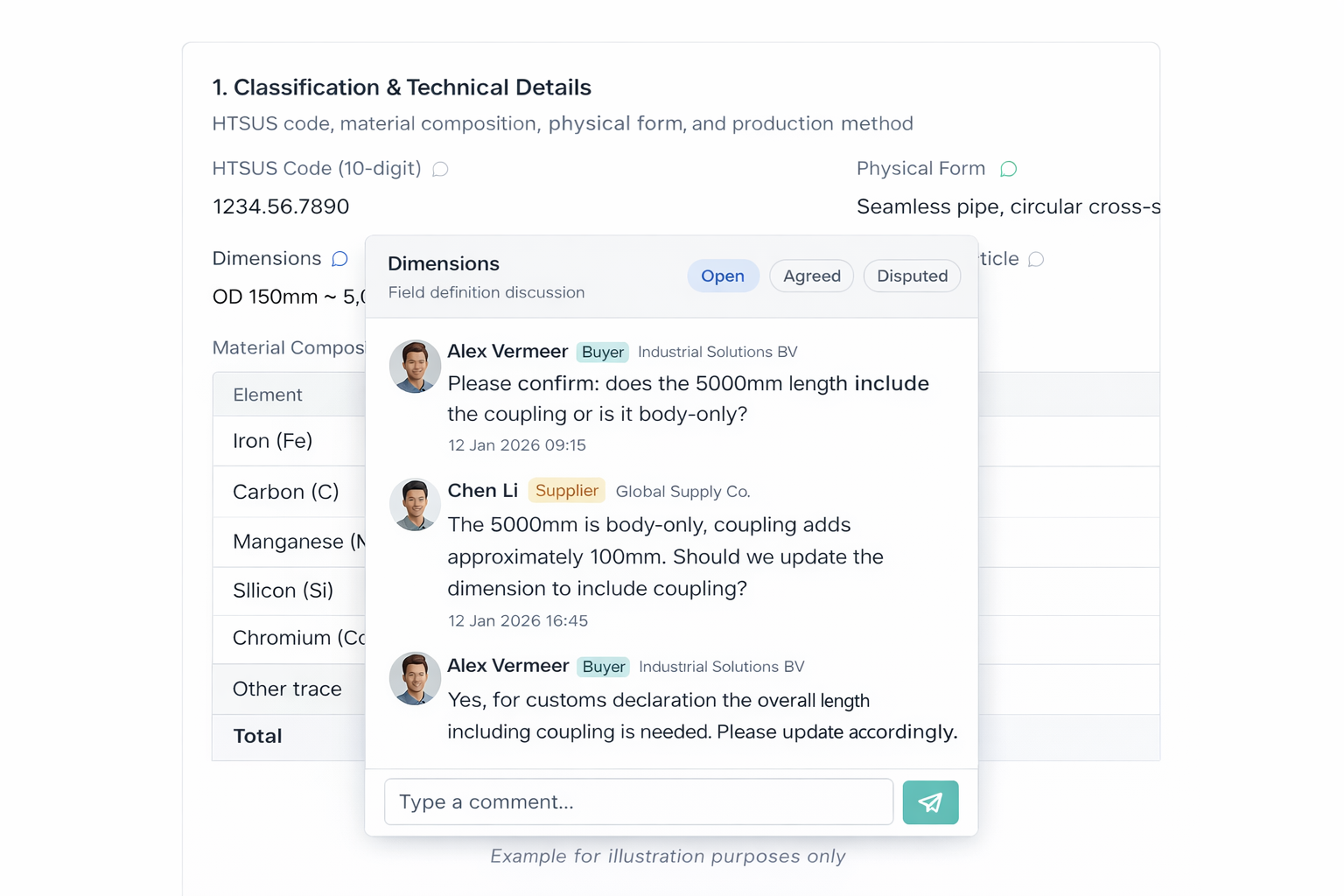
Not slides.
Not future roadmap discussions.
Working software.
From structure to “superpowers”
This is just the starting point.
Quyntess is now preparing to release these capabilities to:
- Turn master data into a collaborative process, not a handover chain
- Strengthen our transactional supply chain applications
- Reduce exception rates by up to 50% within a year
Because ultimately:
If your master data looks like Junk Art, your supply chain will behave like it too.
Want to see what this means in practice?
Curious how this applies to your organization?
Feel free to get in touch or schedule a meeting. We’re happy to share:
• A short recap of the workshop
• A walkthrough of what we built
• How this could apply to your environment
Share this
.png)
Supplier collaboration gives defence manufacturers the edge
%20(2).png)
Renewed U.S. tariffs reveal a deeper issue