
Inside Tradeshift's breakout session at the Supply Chain Innovation Forum 2026, and what to do before your country's mandate lands
Any company invoicing across more than one European country has probably already run into this: a new e-invoicing requirement that wasn't there last year, a supplier asking about Peppol, a deadline someone in finance mentioned in passing without much context. At the Supply Chain Innovation Forum 2026, Tradeshift's Dan Young led a breakout session that pulled these threads together, what's actually driving the changes, who they affect, and what to do before the next deadline arrives.
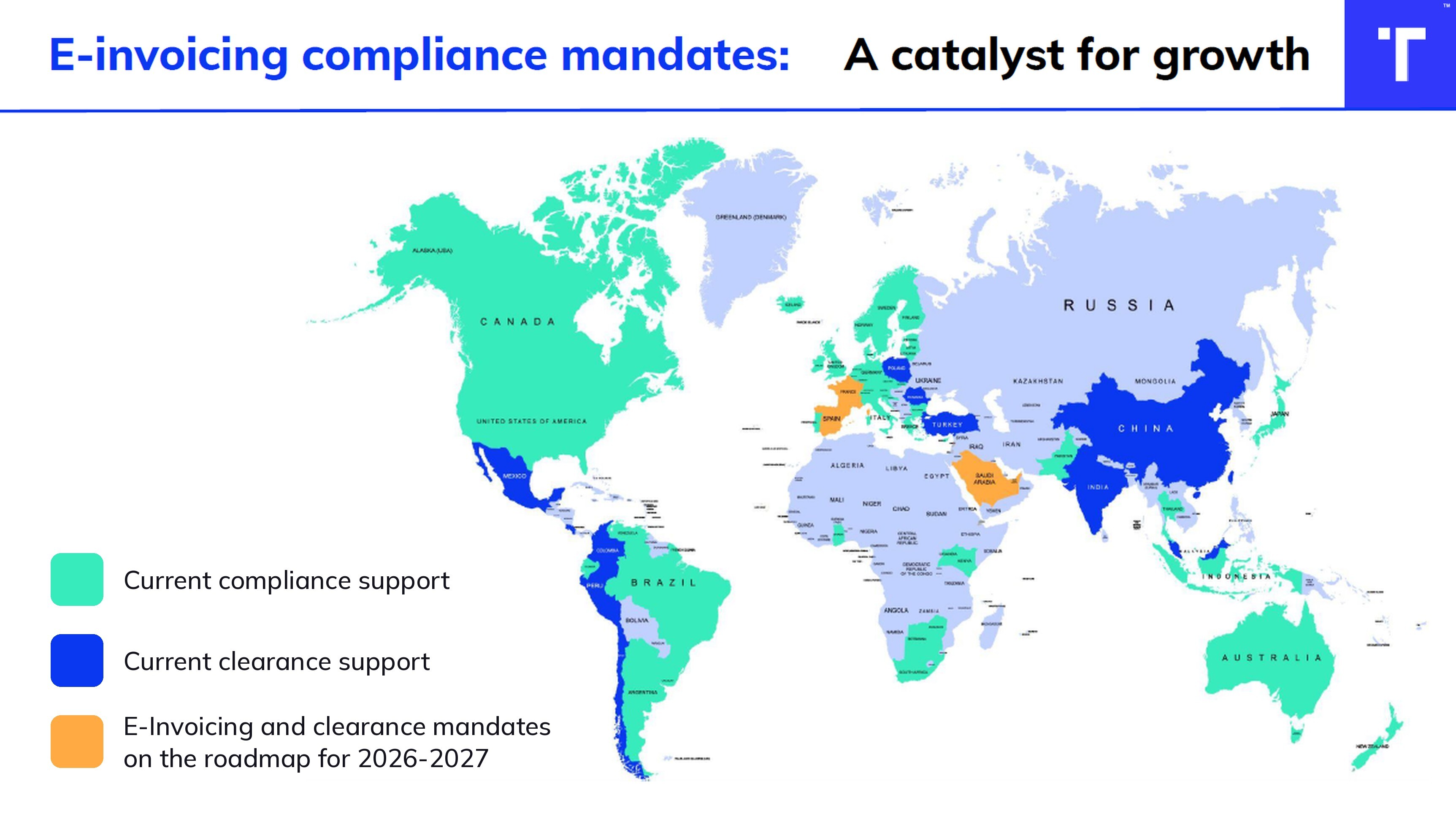
Why the rules are moving so fast
The short answer is tax. Governments across Europe are rolling out electronic invoicing and reporting mandates mainly to close the gap on unreported activity and collect more of what's owed. Spain and Italy were held up as the proof: both saw tax revenue rise meaningfully after introducing early reporting systems, and other countries have taken note.
What makes this harder to plan around is that there's no shared calendar. Major milestones stretch from 2028 out to 2035, and each country is free to pick its own route to get there.
No two countries are doing it the same way
France's mandate went live around 8 September 2026, built on certified service providers that issue and receive invoices on companies' behalf,a model the group described as genuinely complex to operate. Belgium has gone with a four-corner Peppol model based on Peppol v3. Poland runs everything through a central government platform. Germany, more cautiously, mandated invoice formats first and is leaving deeper tax authority integration for a later phase. The UK is still consulting vendors, with a Peppol-based model expected around 2029.
Romania and Luxembourg came up in the same conversation, a reminder that this list is still growing and isn't likely to stop anytime soon.
One more point worth carrying into any planning discussion: companies juggling several of these regimes at once are usually better off with a single compliance provider that can cover multiple jurisdictions, rather than stitching together a different vendor for each country. Spreading the work across providers tends to create as many problems as it solves.
This stopped being just finance's problem
E-invoicing rules touch purchase order collaboration, goods receipt timing, supplier disputes, and payment deadlines, not only tax filings. If goods receipt data ends up starting the payment clock, or feeding directly into compliance reporting, procurement and supply chain teams have a real stake in getting this right. Treating it as a finance-only initiative is exactly how the operational side gets caught off guard.
The session's clearest piece of advice: get finance, procurement, supply chain, tax, IT, and shared service centres into the same planning conversation from day one, rather than briefing them after the decisions are made.
.jpg?width=1890&height=833&name=Blogs%20media%20(3).jpg)
Start 12 to 18 months out
The clearest advice from the session comes down to one number: 12 to 18 months. That's how much lead time companies should give themselves before a mandate takes effect, enough to map which countries apply, understand each one's model and timeline, check how purchase orders, goods receipts, and invoice matching actually work today, and choose a provider without rushing the decision. Wait too long, and implementation happens under pressure, with all the risk that brings.
One thing worth doing regardless of any deadline: tightening order collaboration with suppliers before invoices are even issued. A lot of the corrections that cause problems after a tax authority has already cleared an invoice trace back to something that could have been resolved earlier, a price that didn't match, a delivery date that was never confirmed, a freight charge nobody agreed to. Fix that upstream, and fewer invoices need fixing downstream.
There's a bigger opportunity in here too. Several participants pointed out that a mandatory compliance project doubles as a natural excuse to modernize the wider order-to-invoice-to-payment process, better data quality, more automation, fewer manual exceptions, rather than treating compliance as a narrow box-ticking exercise.
5. What's still uncertain?
Not everything has a clean answer yet. It's not obvious how proposed late-payment rules, 30-day terms floated for business-to-government transactions, 60 days for business-to-business, will sit alongside existing long-term contracts, some running 120 days or longer. Whether that shift becomes a financial risk or an opening for supply chain financing is still genuinely up in the air. And there was a quieter question running through the room: whether procurement and supply chain teams understand these finance-led changes well enough yet to act on them.
A short checklist to start with
Where to go from here
Tradeshift and Quyntess are putting together country-specific compliance guides as a follow-up to the session, if that would be useful, let us know which countries matter most to you.
Beyond that, we can help you work out where you actually stand: which of your markets have mandates coming up, whether you're already inside the 12-to-18-month window, and how to get procurement and finance talking to each other before a deadline forces the issue.
Share this

More suppliers using Tradeshift network
.jpeg)
From EDI to Orchestration: What It Takes to See Six Tiers Deep